Retaining Wall Cost: What to Budget in the Lower Mainland
Retaining walls in the Lower Mainland typically cost $150–$400+ per linear foot. Here's what drives the number — from wall type and height to drainage, engineering, and permits.
There are three main types of retaining walls used in residential construction across BC's Lower Mainland: concrete block, poured concrete, and timber. Each one has genuine strengths and real limitations — and the right choice depends on your site conditions, wall height, budget, and how long you want the wall to last.
We build all three. That means we don't have a financial incentive to push you toward one type over another. This guide breaks down the honest trade-offs so you can make an informed decision — or at least ask the right questions when comparing quotes.
| Factor | Concrete Block | Poured Concrete | Timber |
|---|---|---|---|
| Cost / Sq Ft (Installed) | $25 – $45 | $35 – $60 | $20 – $35 |
| Lifespan | 40 – 60+ years | 50 – 75+ years | 15 – 20 years |
| Max Practical Height | 6 ft (higher with eng.) | 10+ ft (engineered) | 4 ft max |
| Drainage | Excellent (gaps between units) | Good (weep holes required) | Moderate (gaps between ties) |
| Appearance | Wide range of finishes & colors | Smooth, board-form, or textured | Natural, rustic wood grain |
| Maintenance | Minimal — re-level if settling | Very low — seal cracks if any | High — stain, replace rotted members |
| Permit Threshold | Over 4 ft in most cities | Over 4 ft in most cities | Over 4 ft in most cities |
| Best For | Moderate walls, curves, terracing | Tall/structural, modern design | Garden borders, short grade changes |
Disclaimer: The figures above are based on Lower Mainland averages and are intended for educational purposes only. Actual costs vary on a job-to-job basis as material markets move, supply and demand shift, and municipal bylaws change. A free on-site consultation is the only way to get an accurate estimate for your specific project.
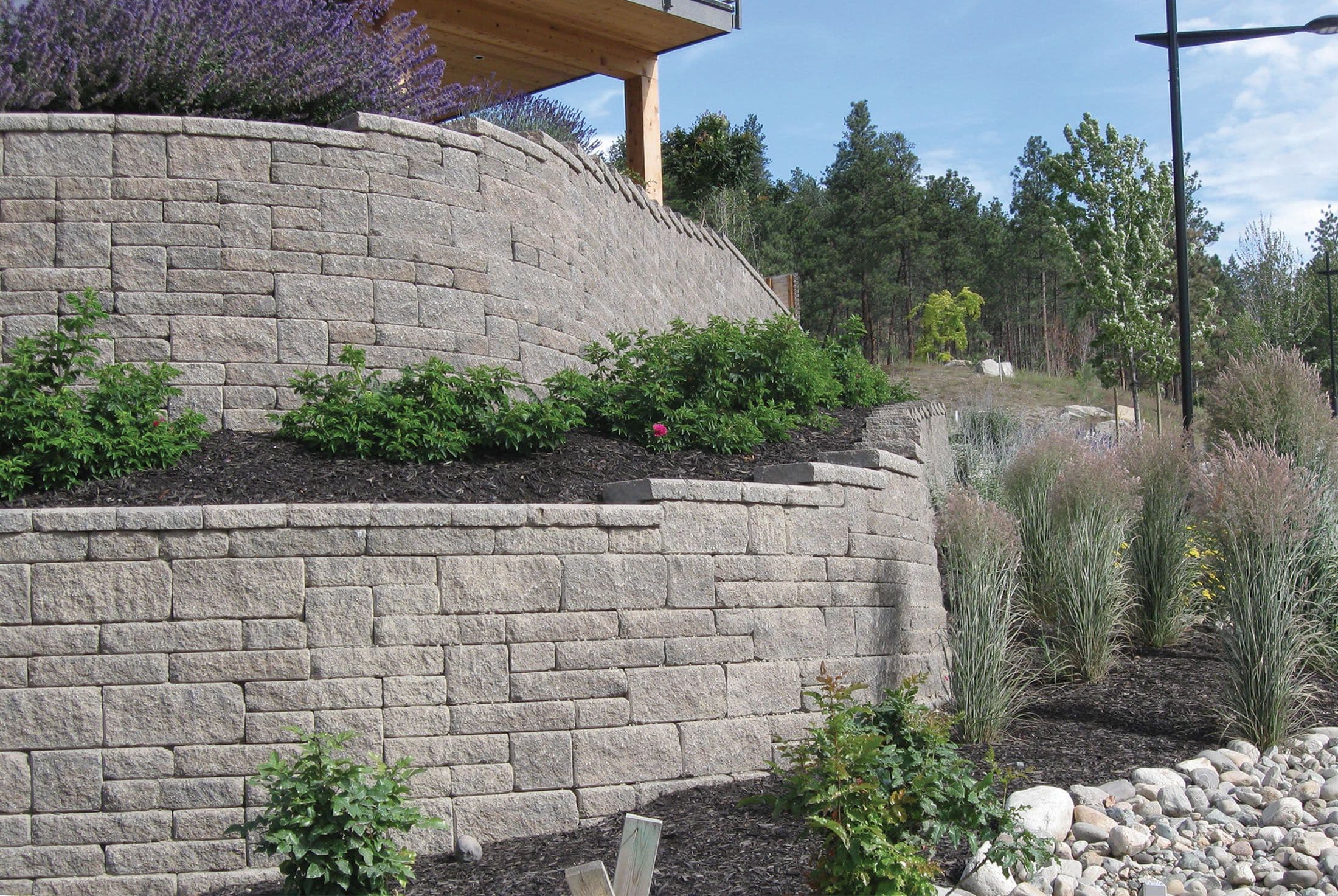
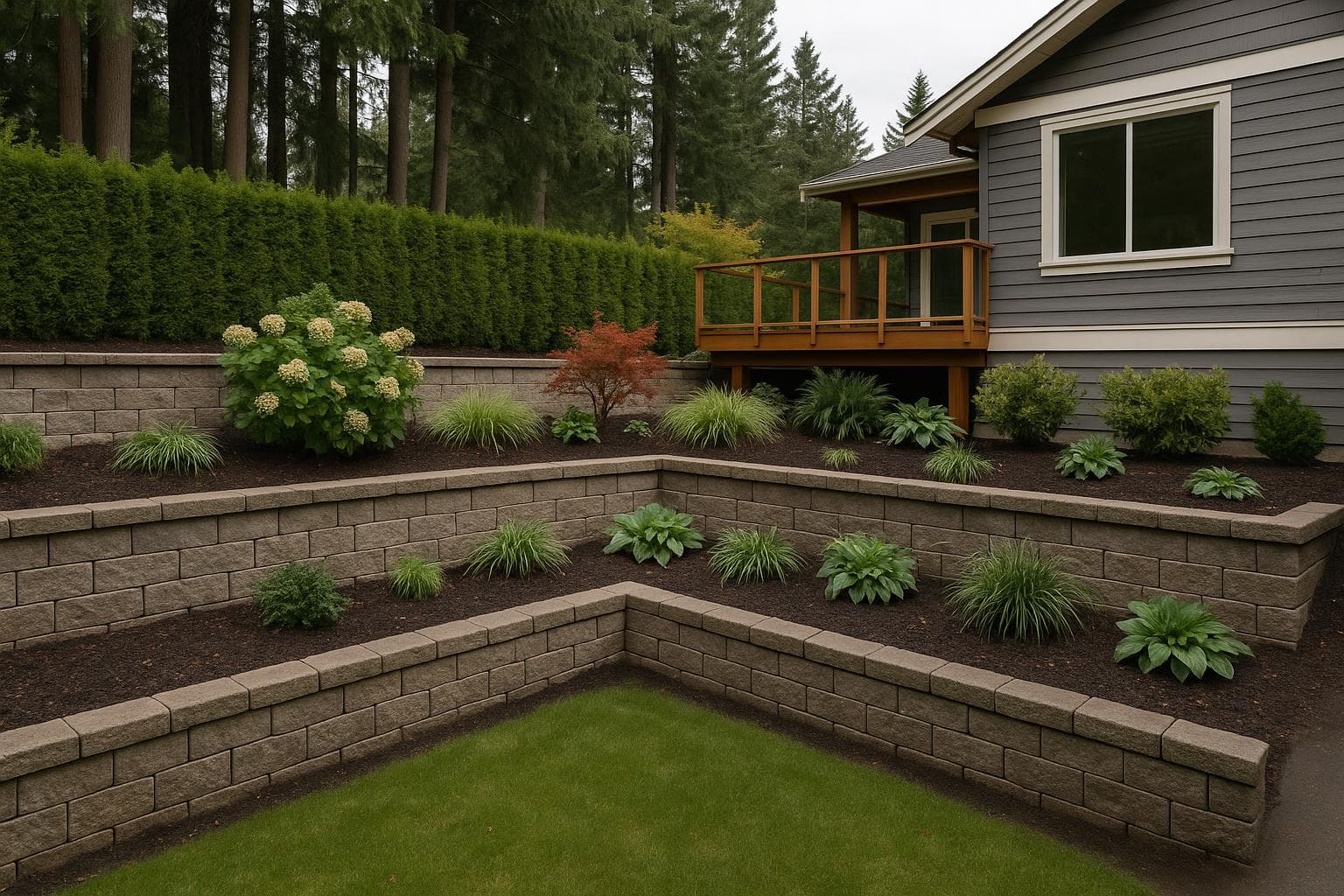
Concrete block walls — including systems like Allan Block, Redi-Rock, and various segmental retaining wall (SRW) products — are the most common type of retaining wall in residential projects across the Lower Mainland. They're modular, widely available, and can handle a broad range of heights and configurations.
Installed cost runs $25 to $45 per square foot of wall face, depending on the block system, wall height, and site access. This is the most cost-effective option for walls under 4 feet. It's also the best choice for curved layouts, terraced slopes, and properties in Surrey or Maple Ridge where moderate grade changes are common.
Poured concrete is the strongest type of retaining wall you can build. It's a monolithic structure — one continuous pour with no joints, no seams, and no individual units that can shift independently. For tall walls, structural applications, and modern architectural design, it's the go-to.
Installed cost ranges from $35 to $60 per square foot of wall face. The cost-per-foot question everyone asks — how much does a concrete retaining wall cost per foot? — depends heavily on height. A 3-foot poured wall might run $105–$180 per linear foot, while a 6-foot wall could hit $210–$360 per linear foot because the concrete volume, forming, and rebar scale exponentially. Poured concrete is the right choice for tall walls (over 4 feet), structural retaining situations where the wall supports a driveway or structure above, and properties in North Vancouver or Coquitlam where steep slopes and heavy soil loads demand maximum strength. It's also what we recommend for architectural concrete projects where the wall is a design feature — board-form finishes, integrated concrete stairs, and clean modern lines.
Timber walls are the cheapest type of retaining wall to build upfront. They use pressure-treated lumber or cedar landscape ties, stacked horizontally and pinned with rebar or deadman anchors. For short garden walls and gentle grade changes, they get the job done at the lowest initial cost.
Installed cost runs $20 to $35 per square foot of wall face. Timber is the most cost-effective retaining wall option if you need a short wall (under 3 feet) on a tight budget and you're comfortable replacing it in 15–20 years. Good for garden borders, raised planting beds, and low-grade transitions on properties where the rustic look works. Not recommended for walls that support anything structural above them.
Regardless of which wall type you choose, drainage is what determines whether your retaining wall lasts 5 years or 50. This is where cheap jobs fail — and it's the part of the job you can't see once the wall is backfilled.
The Lower Mainland gets roughly 1,200mm of rain annually. That water saturates the soil behind your wall, creating hydrostatic pressure that pushes the wall forward. Clay soils — common across Surrey, Burnaby, and Coquitlam — hold water instead of draining it, which makes proper drainage behind the wall even more critical.
Every retaining wall we build includes:
Block walls have a natural advantage here — the gaps between units allow some passive drainage. But that doesn't eliminate the need for a proper drainage system behind them. Timber walls rely on gaps between ties, which close as the wood swells. Poured concrete is watertight by nature, so weep holes and a drain system are non-negotiable. For a deeper look at what goes into retaining wall pricing, including drainage, see our retaining wall cost guide.
Here's a quick decision guide based on common scenarios:
Do you need a permit for a retaining wall in BC? In most Lower Mainland municipalities — Surrey, Burnaby, Coquitlam, North Vancouver, Maple Ridge — the threshold is 4 feet (1.2 metres). Walls above that height require a building permit and, in most cases, stamped structural engineering drawings.
When does a retaining wall need engineering? Beyond the height threshold, engineering is also required when the wall is within a certain distance of a property line, supports a surcharge load (like a driveway, parking area, or building), or is located on a slope with geotechnical concerns. Some municipalities require a geotech report in addition to structural engineering for walls in slide-prone areas.
This applies to all three wall types — block, poured concrete, and timber. The permit threshold is based on retained height, not construction method. For a detailed city-by-city breakdown, see our retaining wall permit guide for BC.
Every project starts with a free on-site consultation. We assess your site, discuss your goals, and provide a transparent, itemized estimate.
There's no single best type of retaining wall — it depends on your site. But after building walls across the Lower Mainland, here's our honest take:
Regardless of type, the two things that matter most are drainage and base preparation. A cheap wall with excellent drainage will outperform an expensive wall with none. We include full drainage specs in every retaining wall quote — itemized, so you know exactly what you're paying for and why.
Tell us about your project and we'll get back to you with a free, no-obligation estimate. We service the entire Lower Mainland.
No obligation
Transparent pricing
IMBL Licensed

Retaining walls in the Lower Mainland typically cost $150–$400+ per linear foot. Here's what drives the number — from wall type and height to drainage, engineering, and permits.

Retaining wall permits in BC depend on height, location, and your municipality. Most cities require permits for walls over 4 feet — but the rules vary. Here's what you need to know.