
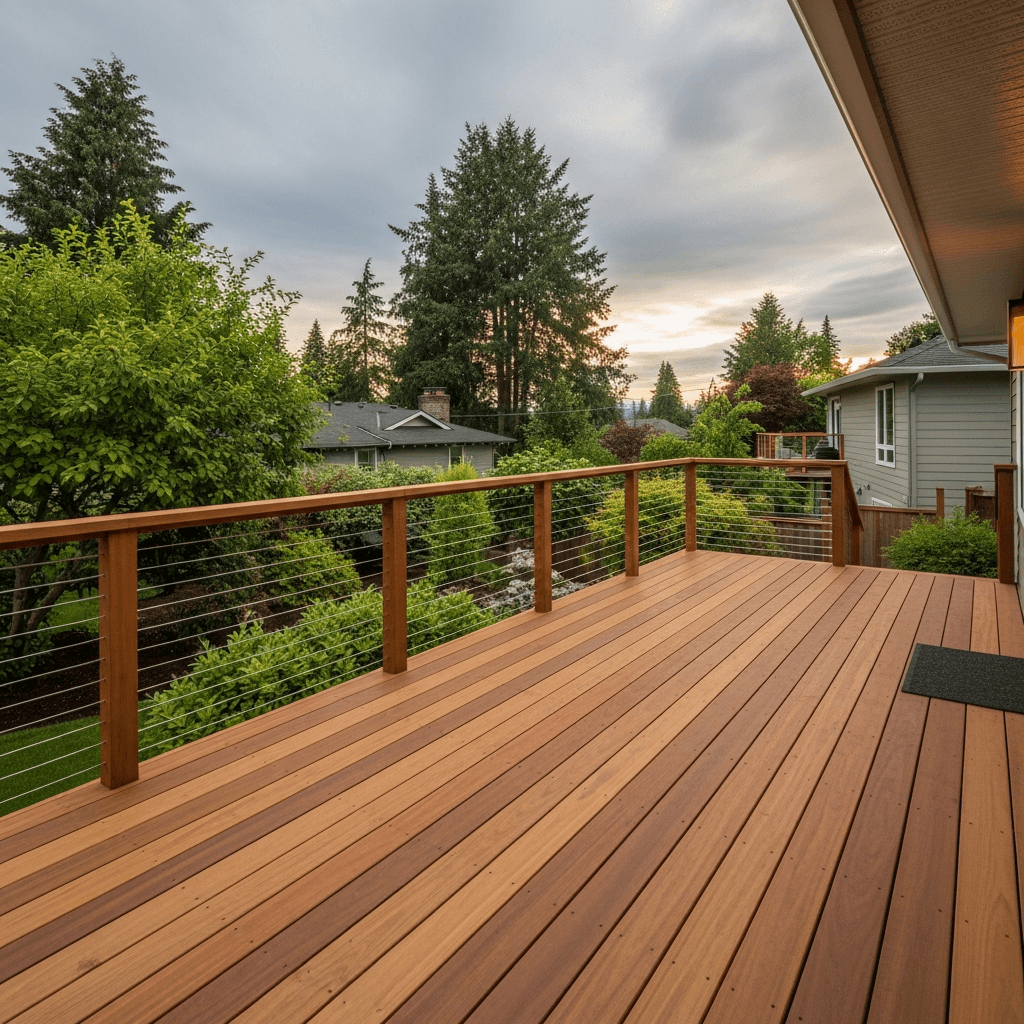
7 min read
Cedar Deck vs Composite Deck: Which Should You Build?
Cedar or composite? One costs less upfront but needs regular maintenance. The other costs more but lasts longer with less work. Here's how to decide.
Mar 12, 2026
"Should I go with wood or composite?" is the first question we hear on almost every deck project in Vancouver, Surrey, and across the Lower Mainland. It's a fair question with no one-size-fits-all answer. Wood costs less upfront. Composite costs less to maintain. And which one actually saves you money depends on how long you plan to keep the deck and how much time you want to spend maintaining it.
We build decks with both materials — cedar, pressure-treated lumber, and every major composite brand. This isn't a pitch for one over the other. It's what we'd tell you over coffee if you asked us which one to pick for your backyard.
| Factor | Wood Deck | Composite Deck |
|---|---|---|
| Installed Cost | $25 – $55 / sq ft | $45 – $85+ / sq ft |
| Installation Time | 3–7 days (typical residential) | 3–7 days (similar framing) |
| Lifespan | 15–25 years (with maintenance) | 25–50 years |
| Maintenance | Stain/seal every 2–3 years | Periodic cleaning only |
| Appearance | Natural grain, weathers over time | Consistent color, realistic textures |
| Structural Strength | Strong — can be reinforced easily | Strong — but requires wood framing |
| Resale Value | Good — buyers appreciate real wood | Very good — low maintenance appeals |
| Environmental | Renewable, biodegradable | Recycled materials, not biodegradable |
Disclaimer: The figures above are based on Lower Mainland averages and are intended for educational purposes only. Actual costs vary on a job-to-job basis as material markets move, supply and demand shift, and municipal bylaws change. A free on-site consultation is the only way to get an accurate estimate for your specific project.
At first glance, wood looks like the obvious budget pick. A pressure-treated wood deck runs $25–$45 per square foot installed, while cedar sits around $35–$55. Composite starts at $45 and can climb past $85 for premium capped brands like TimberTech or Trex Transcend. So how much would a 20x20 composite deck cost? At 400 square feet, you're looking at $18,000–$34,000+ installed, depending on the brand, railing system, and site conditions. A comparable wood deck might come in at $10,000–$22,000.
But the sticker price doesn't tell the whole story. Wood decks need staining and sealing every 2–3 years, and that cost adds up fast:
Is composite decking better than cedar? Not always — but in these situations, it usually is:
They don't. The lifespan of a composite deck is 25–50 years depending on the brand and product line. Entry-level uncapped composites may only last 20–25 years. Premium capped composites (Trex Transcend, TimberTech AZEK, Fiberon Paramount) are the ones pushing 40–50 years. And the framing underneath is still pressure-treated wood that has its own lifespan. No decking material is truly permanent.
Cedar and properly maintained pressure-treated lumber can last 15–25 years or longer in the Lower Mainland. The key words are "properly maintained." If you seal your deck on schedule and keep it clean, wood holds up well. The decks that rot prematurely are the ones that never got sealed, sit in permanent shade with no airflow, or were built with inadequate drainage underneath.
This was true 10–15 years ago. Early composites had a flat, plastic appearance that looked nothing like wood. Modern capped composites have multi-tonal color streaking, realistic wood grain embossing, and matte finishes that genuinely fool people at a glance. They still don't feel like wood underfoot — composite is denser and smoother — but the visual gap has closed dramatically.
Our climate is one of the toughest for decking in Canada. Heavy rain from October to April, moss growth year-round in shaded areas, and strong summer UV all affect both materials differently:
Every project starts with a free on-site consultation. We assess your site, discuss your goals, and provide a transparent, itemized estimate.
There's no universal winner. Are composite decks worth the money? Yes — if you plan to stay long-term and don't want the maintenance commitment. Is wood the wrong choice? Not at all — if you prefer natural aesthetics, have a tighter budget, or enjoy the upkeep. The downsides of composite decking are real: higher upfront cost, it gets hotter in direct sun, and it can't be sanded or refinished. The downsides of wood are also real: ongoing maintenance, shorter lifespan without it, and susceptibility to moisture in our climate.
Wondering if a concrete patio might be a better fit altogether? It often is for ground-level outdoor living spaces — and the cost can be significantly lower. Check our concrete patio service page or our stamped concrete vs pavers comparison for that angle.
For a deeper dive into cedar specifically, read our cedar vs composite deck comparison. And when you're ready to talk specifics for your property in Burnaby, North Vancouver, Langley, or anywhere in the Lower Mainland — we'll give you a straight answer on which material makes sense for your situation, your budget, and your yard.
Tell us about your project and we'll get back to you with a free, no-obligation estimate. We service the entire Lower Mainland.
No obligation
Transparent pricing
IMBL Licensed